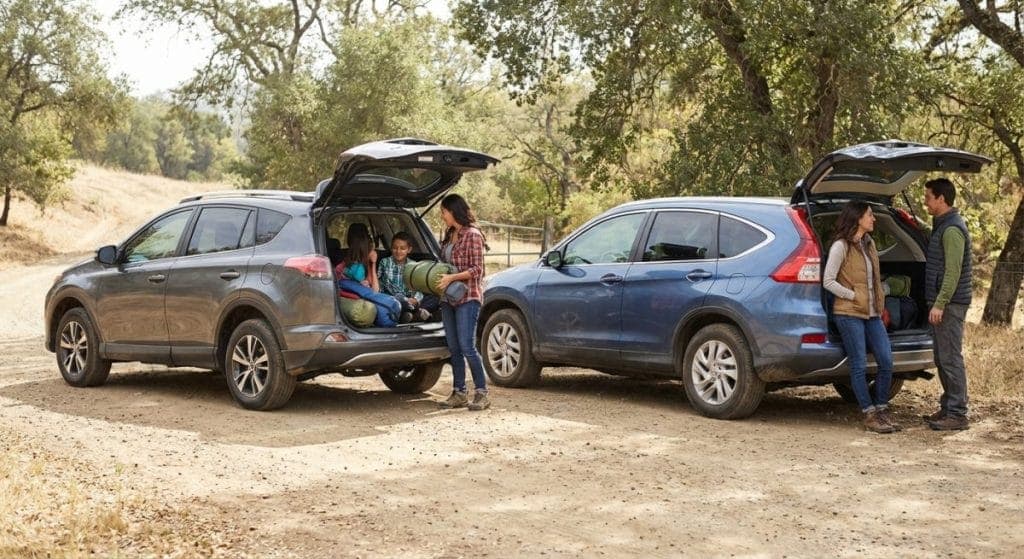
You’ve narrowed it down to two of the most popular compact SUVs on the used car market, and now you’re stuck. The Toyota RAV4 and the Honda CR-V both have massive fan bases, strong resale value, and years of reliability data behind them. So which one should you actually buy?
Let’s break it down properly so you can stop going back and forth and just make the call.
The Two Compact SUV Heavyweights Battle It Out
The RAV4 and the Honda CR-V have been trading blows for decades. They’re consistently among the top-selling vehicles in North America, which means used examples are everywhere. That’s good news for you. Plenty of supply usually means better pricing and more options to be picky about condition, mileage, and trim level.
Both are smart picks as a used car. But they’re not identical, and the differences matter depending on how you drive and what you need day to day. Want to browse used cars by make before reading further? Go for it. Otherwise, let’s get into it.
Toyota RAV4 Basics
The Toyota RAV4 has been around since 1994, and the fourth and fifth generations (2013 to present) are what you’ll mostly find on the used market. The fifth-gen RAV4, which launched for 2019, brought a more rugged look, better standard features, and a hybrid powertrain that seriously raised the bar for fuel economy in the segment.
A base RAV4 LE gets you around 27 mpg city and 35 mpg highway with the 2.5-liter four-cylinder, according to EPA fuel economy data. The RAV4 Hybrid bumps that up significantly, pulling around 41 mpg city and 38 mpg highway. That’s a huge gap, and if fuel economy matters to you, the RAV4 Hybrid is hard to argue with.
Toyota’s reputation for reliability is the other big draw. The RAV4 consistently shows up on long-term reliability surveys as one of the safer bets in its class. That peace of mind has real dollar value when you’re buying used.
Honda CR-V Basics
The Honda CR-V has its own loyal following, and for good reason. The fifth-generation CR-V (2017 to 2022) brought turbocharged power, a more refined interior, and excellent cargo space. The sixth-gen model that arrived for 2023 doubled down on the hybrid powertrain, making the Honda CR-V Hybrid the volume seller it is today.
A non-hybrid Honda CR-V with the 1.5-liter turbo typically gets around 28 mpg city and 34 mpg highway, which is competitive. The CR-V Hybrid steps up to around 40 mpg city and 35 mpg highway, very close to RAV4 Hybrid territory in real-world driving.
Honda has always leaned into the driving experience, and you feel that in the CR-V. The steering is a little more responsive, and the cabin tends to feel more polished, especially at mid-range trim levels. Reddit users comparing both vehicles frequently mention that the CR-V’s interior feels nicer at similar price points, and that tracks with what you’ll find in person.
Toyota RAV4 vs. Honda CR-V: Reliability and Maintenance
Both of these SUVs hold up well over time. But there are some differences worth knowing before you buy.
The RAV4, particularly the hybrid version, has an excellent track record. Toyota’s hybrid system has been around since the late 1990s and is considered one of the most durable on the market. If you find a used RAV4 Hybrid with high mileage, it’s generally less of a concern than with other brands’ hybrid systems.
Honda CR-V models from 2017 to 2020 did have a known issue with oil dilution in cold climates. Engine oil would occasionally get contaminated with gasoline, particularly in colder weather driving. Honda acknowledged this and updated software in later models. It’s not a dealbreaker, but it’s something to ask about and check with a free VIN lookup tool before you commit to a purchase.
Always get an independent pre-purchase inspection on either vehicle. This isn’t optional advice. It’s the single best way to avoid an expensive surprise in the first year of ownership.
Performance and Fuel Economy
Neither of these SUVs is built to win stoplight races. They’re family haulers, and they both do that job well. The RAV4’s 2.5-liter naturally aspirated engine makes around 203 horsepower. It’s smooth, predictable, and easy to live with.
The Honda CR-V’s turbocharged 1.5-liter makes 190 horsepower but feels peppier in everyday driving thanks to the turbo’s low-end torque. If you do a lot of city driving or highway merging, you’ll probably appreciate the CR-V’s throttle response more.
For the hybrid versions, both get the job done well. The RAV4 Hybrid adds standard all-wheel drive (it uses electric motors for the rear wheels), which is a meaningful advantage if you live somewhere with snow. The CR-V Hybrid is also available with AWD but it’s worth checking the specific listing since not every trim comes standard with it.
On mpg, the gap between hybrid and non-hybrid is significant enough that if you plan to keep the vehicle more than three years, the RAV4 Hybrid or CR-V Hybrid will likely offset the slightly higher purchase price through fuel savings.
Interior Space and Comfort
Cargo space is one area where the RAV4 has a measurable edge. The RAV4 offers around 37.8 cubic feet behind the second row and about 70.4 cubic feet with the rear seats folded, according to U.S. News. The Honda CR-V comes close, with roughly 36.3 cubic feet behind the rear seats and 68 cubic feet total. Both are excellent for a compact SUV, but the RAV4 does nudge ahead if you’re frequently loading gear.
Where the CR-V often wins is rear passenger space. It feels a little more generous for adult rear-seat passengers, and the seat cushioning tends to get better reviews for longer trips. If you regularly carry adults in the back, sit in both before you decide.
Trim level matters a lot in this comparison. A base RAV4 LE can feel noticeably cheaper than even a mid-range Honda EX trim. The RAV4 opens up considerably once you get to the XLE or XLE Premium. Keep that in mind when you’re comparing prices on used listings.
Why Buy a Used Toyota RAV4?
The RAV4’s biggest advantages as a used purchase come down to hybrid availability, cargo room, and Toyota’s long-term reliability reputation. Used RAV4 Hybrid models hold value well, which means you’ll pay a bit more, but you’re also getting a vehicle that tends to last. The standard AWD on the hybrid variant is a genuine feature, not just a checkbox.
The RAV4 also has a wider variety of trim levels to choose from on the used market, including the off-road-focused RAV4 TRD Off-Road and the more premium RAV4 Adventure trim. That gives you more flexibility depending on your lifestyle.
Why Buy a Used Honda CR-V?
The Honda CR-V makes a strong case based on interior refinement, driving feel, and rear passenger space. If you want a compact SUV that feels more like a grown-up car and less like a utility box, the CR-V tends to deliver that better at similar price points.
The Honda CR-V Hybrid is especially compelling if you can find a clean used example. It’s smooth, efficient, and Honda has ironed out most of the early issues in newer model years. The fifth-gen CR-V (2017 to 2022) is widely available used and gives you a lot of value for the money, just watch for the oil dilution issue on early 2017 to 2020 models as mentioned above.
Honda’s dealer network is strong and parts are widely available, which keeps maintenance costs reasonable over the long haul.
Used Toyota RAV4 vs Honda CR-V: Which One Is Right for You?
If you need max cargo space, want standard AWD on a hybrid, or prioritize long-term reliability above all else, the used Toyota RAV4 is probably your pick. The RAV4 Hybrid in particular is one of the best used compact SUVs you can buy right now if the budget is there.
If you care more about how the SUV feels to drive, want a more premium interior without stepping up to a luxury badge, or frequently carry adults in the back seat, the used Honda CR-V is worth the serious look it deserves. The CR-V Hybrid hits a sweet spot of efficiency and refinement that’s hard to beat.
Neither of these is a bad choice. Buyers in the USA, Canada, and elsewhere have been choosing between these two for years precisely because both are that good. The right one is the one that fits how you actually live.
You Really Can’t Go Wrong
At the end of the day, both the RAV4 and the Honda CR-V are battle-tested, widely serviced, and hold up over hundreds of thousands of miles when maintained properly. Used examples of either are abundant, which keeps prices honest.
The RAV4 leans practical and rugged. The CR-V leans refined and car-like. Your job is to figure out which of those two personalities fits your driveway better.
Check for any open NHTSA recalls on any specific vehicle you’re considering. Run a free VIN lookup to check the vehicle history. And before you sign anything, get that independent inspection done. Whether you go RAV4 or CR-V, those steps apply every single time.
When you’re ready to crunch the numbers on financing, our car loan calculator can help you figure out what monthly payment actually looks like at different loan terms and interest rates. That’s the number that matters when you’re standing in a dealer lot trying to make a decision.
Go test drive both. Back to back if you can. You’ll know pretty quickly which one feels like yours.
Was this helpful?
Put it to work. Research your next car or browse our top gear picks.