Your car gives you warnings before the transmission dies. Most people just don’t know what to listen for, or what to look at, until they’re already stranded or staring at a four-figure repair quote. Here’s how to catch the problem early.
What Is a Transmission, Anyway?
The transmission is the system that takes power from your engine and sends it to the wheels. It manages all your gear changes, whether you’re doing that yourself or letting the car handle it automatically. Without a working transmission, your engine can rev all day long and the car won’t go anywhere useful.
Think of it as the middleman between your engine and your wheels. When that middleman starts failing, you’ll feel it, hear it, and sometimes smell it. The trick is recognizing those signals early.
Two Types of Automatic Transmission You Should Know About
Not all automatic transmissions work the same way, and that matters when you’re trying to figure out what’s wrong.
A traditional automatic transmission uses a set of planetary gears and a hydraulic torque converter to shift between gear ratios. These are the units most people are familiar with, found in the majority of trucks, SUVs, and older sedans. They’re generally durable, but they’re not immune to wear.
A CVT (continuously variable transmission) uses a belt-and-pulley system instead of fixed gears. You’ll find CVTs in a lot of newer fuel-efficient cars, especially from Honda, Nissan, and Subaru. Instead of stepping through gear ratios, a CVT slides through them smoothly. The signs that your CVT transmission is going bad can be a little different from a traditional automatic, including a distinctive rubber-band feeling when you accelerate, a high-pitched whine under load, or sudden jerking that wasn’t there before.
Both types share many of the same warning signs, but knowing which transmission you have helps you describe symptoms accurately to a shop.
What Are the Signs of a Bad Transmission?
This is the part you actually came here for. These are the real-world symptoms that tell you something’s wrong, some obvious, some easy to miss.
Slipping Gears
Gear slipping is one of the clearest signs a transmission is going bad while driving. It feels like the car suddenly loses power, the engine revs higher than normal for your speed, and then catches again. It might happen once and never repeat, or it might happen constantly.
In newer vehicles, slipping gears can trigger additional warnings. Some GM models, for example, may show StabiliTrak warnings or enter limp mode when a transmission issue causes a drop in fluid pressure. Don’t dismiss those dash warnings as unrelated.
Delayed or Rough Shifting
Your transmission should shift gear changes smoothly, with almost no drama. If you notice a hard clunk when moving from park to drive, or a long pause before the car actually engages, that’s your transmission telling you something’s off. Rough shifting that gets worse over time is a transmission problem worth taking seriously right away.
A Whine, Grind, or Clunk You Can’t Explain
Any strange noise coming from your transmission is out of place. A whine that gets louder when you press the accelerator, especially when paired with sluggish acceleration, often points to low transmission fluid or a failing torque converter. A grinding sensation during gear changes typically means worn gear components. A clunk when shifting is hard to ignore and just as hard to justify leaving unchecked.
CVTs in particular tend to whine when they’re struggling. If you have a CVT and you’re hearing a high-pitched whine during acceleration, get it looked at sooner rather than later. CVT repairs are expensive, and catching issues early gives you more options.
Transmission Fluid Leak
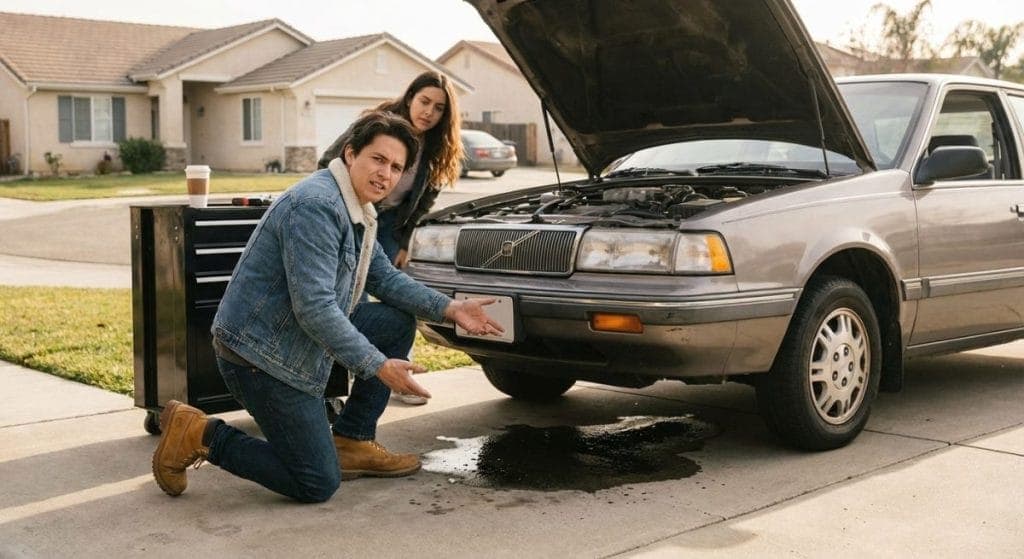
A transmission fluid leak is one of the most straightforward warning signs, because you can actually see it. Transmission fluid is typically a bright red color and has a slightly sweet smell when fresh. As it ages and burns, it turns dark brown or black.
If you spot a red or brownish fluid under your car, especially near the center or toward the rear of the engine bay, you likely have a transmission fluid leak from a cooler line, gasket, or seal. A leak isn’t just a transmission problem on its own. If fluid drips onto a hot exhaust pipe, it becomes a fire hazard. Don’t sit on this one.
When you’re buying a used car, always check the ground under where it’s been parked. A transmission fluid leak shows up as a stain, and sellers won’t always clean that up before you arrive. You can also run a free VIN lookup to check for any prior damage or maintenance records that might hint at a history of fluid issues.
The Check Engine Light
A lot of buyers assume the check engine light means something minor, like a loose gas cap. Sometimes that’s true. But the check engine light can also reflect a transmission issue, because modern vehicles use sensors throughout the transmission to monitor performance. If that light comes on alongside any other symptom on this list, treat it as urgent.
A mechanic can absolutely tell if your transmission is going bad, often before you can. A proper scan of your vehicle’s diagnostic codes will reveal transmission-specific fault codes that point toward the source of the problem. Don’t clear the codes and hope for the best.
Burning Smell
A burning smell that seems to come from under the hood or beneath the car is worth taking seriously. When transmission fluid overheats, it breaks down and starts to smell like something burning, sometimes almost like scorched rubber or hot plastic. If your transmission is overheating regularly, the fluid isn’t doing its job anymore, and internal components start to wear much faster.
Overheating is especially common if you tow frequently, drive in stop-and-go traffic, or live somewhere with extreme heat. A transmission that overheats repeatedly will fail faster than one that runs cool, full stop.
The Car Won’t Go Into Gear
This one’s hard to ignore. If you move the shifter into drive or reverse and nothing happens, or the car hesitates for several seconds before moving, your transmission is struggling. In a manual, this can sometimes be traced to a clutch problem rather than the transmission itself. A worn or slipping clutch can mimic transmission symptoms closely, so it’s useful to know which you have before assuming the worst.
Either way, a car that won’t go into gear reliably isn’t safe to drive. Get it inspected before you get stuck somewhere inconvenient.
Shaking or Jerking While Driving
Smooth acceleration is a sign of a healthy drivetrain. If your car shudders, jerks, or hesitates when you accelerate from a stop, or vibrates during highway cruising when it should be locked into a steady gear, your transmission could be the culprit. This is especially telling in CVT-equipped vehicles, where jerky acceleration often means the belt or pulleys are worn.
Transmission Overheating Warning
Some vehicles have a dedicated transmission temperature warning light or message. If yours lights up, pull over safely when you can and let the car cool down. Continuing to drive an overheating transmission causes damage that compounds fast. Check your transmission fluid level once the car has cooled, and have the system inspected before driving further.
Checking Transmission Fluid Yourself
On many vehicles, you can check your transmission fluid level with a dipstick, similar to how you’d check your oil. The fluid should sit between the marked lines on the dipstick, and it should look clean, ranging from pinkish-red to light brown. Dark, black, or gritty fluid means it’s overdue for a service. A burnt smell from the fluid itself confirms the transmission has been running hot.
Some newer vehicles have a sealed transmission with no dipstick at all. If that’s your car, checking the fluid level requires lifting the vehicle and removing a fill plug, which is a shop job. Don’t skip this check just because it’s inconvenient.
Should You Buy a Car With Transmission Problems?
This is the real question if you’re shopping for a used car. The honest answer is: sometimes, but only if you know exactly what you’re getting into.
A transmission problem that’s just a fluid leak or a dirty filter can be cheap to fix. A transmission that’s slipping, grinding, or won’t shift properly could mean a full rebuild or replacement, which can run anywhere from a few hundred dollars to several thousand depending on the vehicle. Make sure you have an independent inspection done by a trusted shop before you commit to buying anything with a questionable transmission.
You can start your research before you even see the car in person. A free VIN lookup can surface recall history, reported damage, and service records. Combine that with a pre-purchase inspection and you’ll have a much clearer picture of what you’re actually buying. If you need to crunch the numbers on financing a repair alongside the purchase, our car loan calculator can help you figure out what fits your budget.
If you want to compare vehicles with known reliability histories, browse used cars by make and look for models with strong transmission track records before you narrow down your search.
What to Do If You Spot These Signs
Don’t wait and hope it goes away. Transmission problems almost never fix themselves, and they almost always get worse with time. The cost of a fluid service or a minor repair is a fraction of what a full transmission replacement runs.
If you’re shopping for a used car and you notice any of these symptoms during a test drive, that’s your signal to walk away or negotiate hard with a professional inspection in hand. A car that slips gears, leaks fluid, or makes unexplained noises during your test drive will do all of those things even more enthusiastically six months after you buy it.
Get a mechanic to scan for transmission-related codes, check the fluid condition, and physically inspect for leaks before you hand over any money. That single step can save you from a very expensive mistake.
Was this helpful?
Put it to work. Research your next car or browse our top gear picks.