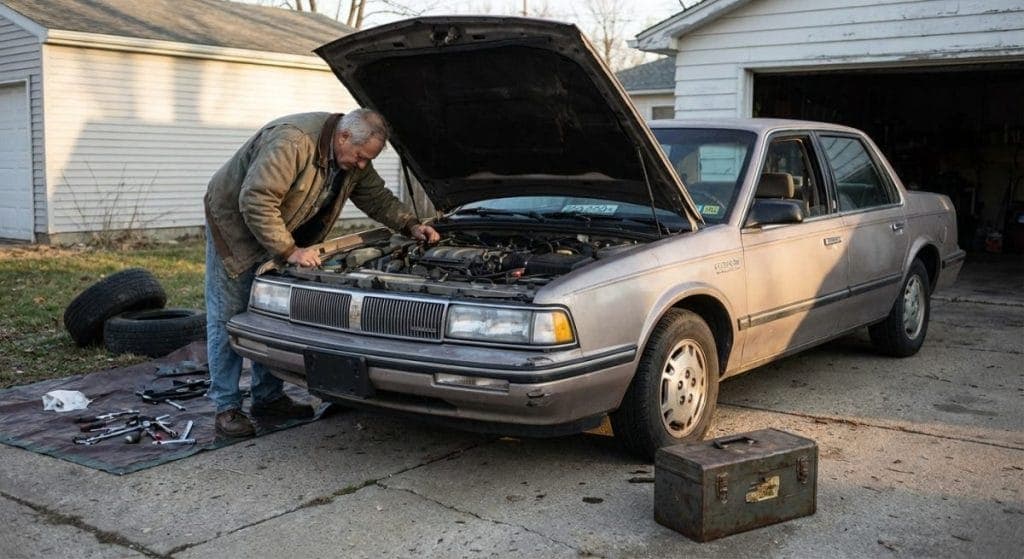
You’re staring at a repair estimate that costs more than what you paid for your car. Now you’re wondering whether to fix it or cut your losses. It’s one of the most stressful decisions a car owner faces, and there’s no single right answer.
The good news is there’s a practical framework for thinking through it. Whether you’re dealing with a transmission job, a brake overhaul, or something even bigger, here’s how to figure out what actually makes sense for your wallet and your situation.
What’s Considered High Mileage?
The definition of high mileage has shifted a lot over the years. A decade or two ago, 100,000 miles felt like the end of a car’s useful life. Today, thanks to better engineering and improved fluids, that bar has moved significantly.
Most mechanics and automotive experts consider anything over 150,000 miles to be high mileage territory. But a car with 200k miles isn’t automatically a lost cause. Mileage is just one data point, and it’s not even the most important one.
The make and model matters enormously here. A Toyota Camry or Toyota Corolla with 200k miles is a very different proposition than a lot of other cars at the same number. Toyota has earned its reputation for building engines that just keep going, and the Reddit community that follows high-mileage vehicles will be quick to point you toward stories of Toyota Land Cruisers and Lexus LS400s rolling past a million miles with the right care.
Assessing the Condition of a High-Mileage Car
Before you can answer whether a repair is worth it, you need an honest picture of what you’re actually working with. Mileage tells you how much the car has been used. Condition tells you how it’s been treated.
A car that’s had regular maintenance, fresh oil changes, and timely brake jobs throughout its life is going to be in far better shape at 200k miles than one that’s been neglected. Service records are gold here. Ask for them, and actually look through them.
Look for these signs when evaluating any high-mileage vehicle:
- Rust on the frame or undercarriage. Surface rust on body panels is cosmetic. Rust eating through structural components is a completely different problem, and it can make a car not worth fixing regardless of how well the engine runs. One Reddit user shared a story about a car that was structurally sound mechanically but had a frame that had completely rotted out, making it a write-off despite its running condition.
- Transmission behavior. A slipping, shuddering, or hesitating transmission is a serious warning sign. Transmission repair is one of the most expensive jobs a shop can do, and a failing transmission on a high-mileage car changes the math fast.
- Brake condition. Worn brake pads are a routine repair. Warped rotors, a soft brake pedal, or brake fluid that hasn’t been changed in years points to deferred maintenance that multiplies the repair list quickly.
If you’re looking at a used car and you haven’t had it inspected yet, stop. Get a pre-purchase inspection from an independent mechanic before you spend a dollar. It typically costs $100 to $150 and can save you thousands.
Is It Worth Fixing a Car With 200k Miles?
Here’s the rule of thumb that most repair shops, including Christian Brothers Automotive, use: if the repair cost is less than or around 50% of the vehicle’s current market value, it’s generally worth doing. That’s a useful starting point, but it’s not the whole picture.
Say your car is worth $4,000 and you’re looking at a $1,800 brake and suspension repair. That’s 45% of the car’s value. Painful, yes. But probably worth it, especially if the rest of the car is solid.
Now say you’re facing a $3,500 transmission repair on that same $4,000 car. That’s nearly 90% of the car’s value, and you still don’t know what else might break next. That’s a much harder sell.
The real question isn’t just about this one repair. It’s about what comes after. A car with consistent regular maintenance and a good track record is more likely to give you several more reliable years after a major repair. A car that’s been neglected and is now stacking up repair after repair is telling you something.
Think about your repair costs over the past 12 months too. If you’ve already spent $2,000 on repairs this year and now you’re looking at another $2,500 job, the cumulative cost starts looking a lot like a car payment, without any of the reliability of a newer vehicle.
Understanding Your Car’s Current Condition
Condition isn’t just mechanical. It’s financial too. What does your car actually worth right now? Check a few sources like Kelley Blue Book or similar tools to get a realistic number based on your car’s year, trim, mileage, and actual condition. Don’t use the optimistic estimate. Use the honest one.
Once you know the market value, stack your repair estimate against it. That 50% threshold becomes a real number you can work with instead of a vague concept.
Also factor in what the repair actually fixes. A brake job or a timing belt replacement is maintenance. It keeps the car running safely. A transmission rebuild is a major repair that could add years to the car’s life, or could be the first domino in a longer list of expensive problems. Your mechanic’s honest assessment of the rest of the car matters a lot here.
Ask your mechanic directly: if we do this repair, what else are you seeing that might need attention in the next year? A good mechanic will tell you. If the answer is “a lot,” that changes your calculus.
Evaluating Repair Costs vs. Car Value
Let’s get specific about repair costs because the range is enormous depending on what’s broken.
Brake work, including pads, rotors, and brake fluid, typically runs a few hundred dollars per axle. That’s usually worth doing on almost any car that’s otherwise in decent shape, because brakes are non-negotiable for safety and the repair cost is relatively low.
Transmission repair or replacement is a different story. Depending on the vehicle, a rebuilt transmission can run $1,500 to $4,000 or more. On a Toyota Tacoma or Toyota 4Runner with solid bones and documented history, that repair might make complete sense. On an old car with rust problems, a rough interior, and unknown service history, it probably doesn’t.
Engine work sits in a similar category. A head gasket repair might run $1,000 to $2,000. An engine replacement can run $3,000 to $6,000 or more. Use our car loan calculator to compare what those repair costs look like against monthly payments on a replacement vehicle. Sometimes the numbers actually favor the repair.
The total repair costs need to be seen in context. Spreading $3,000 in repairs over two to three more years of ownership works out to roughly $100 to $125 per month. That’s significantly less than a car payment on almost anything.
Considering Long-Term Reliability
This is where brand reputation genuinely matters. A Toyota at 200k miles, especially one with documented service history, has a fundamentally different long-term outlook than many other vehicles at the same mileage. Toyota’s engineering philosophy prioritizes durability, and the data backs that up consistently.
If you own a Toyota Corolla, Toyota Camry, or Toyota Highlander and you’ve kept up with your oil changes, brake service, and transmission fluid, the odds are good that your car has meaningful life left after a major repair. The same logic applies to a handful of other brands known for longevity, but Toyota comes up most often in these conversations for good reason.
If your car is a make or model with a spottier reliability record, or if you genuinely don’t know how well it was maintained, you’re taking on more risk with every large repair you authorize. A free VIN lookup tool can help you pull the vehicle history and see what you’re actually dealing with before you commit to anything.
If You Can Afford It, It May Be Time to Buy a Newer Car
Sometimes the math just doesn’t work. If your repair estimate is high, your car’s value is low, and you’ve already spent a significant amount on repairs this year, it might be time to let it go.
Buying a new car or a newer car comes with its own costs, obviously. Depreciation, insurance, taxes, and financing all add up. But if your current car is becoming unreliable and the repair costs keep stacking up, the financial and practical case for moving on becomes harder to argue against.
If you’re considering replacing your vehicle, browse used cars by make to find well-maintained options that fit your budget. A certified pre-owned vehicle with lower mileage and a warranty is often a smarter buy than pouring money into a car that’s sending you mixed signals about its future.
The Final Verdict: Making the Right Decision
There’s no universal answer here, but there is a clear process. Start with your car’s actual market value. Get an honest repair estimate in writing. Apply the 50% rule as a starting point. Factor in your car’s service history, its make and model reputation, any rust or structural concerns, and the condition of critical systems like the transmission and brakes.
Then ask your mechanic what else they see coming. If the repair fixes a specific problem and the rest of the car checks out, fixing it usually makes financial sense. If you’re playing whack-a-mole with a list of repairs that keeps growing, it’s probably time to move on.
Whatever you decide, get that inspection first. Run the VIN through a free VIN lookup tool to check for accidents, title issues, and prior damage. Make your decision with real information, not guesswork. That’s the only way to come out ahead.
Was this helpful?
Put it to work. Research your next car or browse our top gear picks.