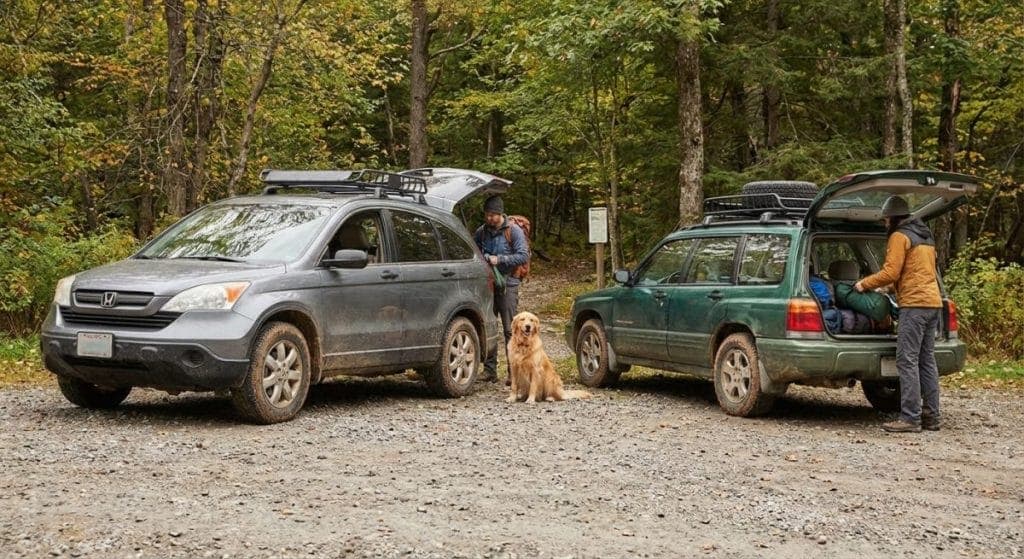
You’ve narrowed it down to two solid compact SUVs, and now you’re stuck. The Honda CR-V and the Subaru Forester both show up on almost every “best used compact SUV” list, and for good reason. But they’re not the same vehicle, and the right choice depends entirely on how you actually plan to use it.
This guide breaks down everything you need to know before you hand over your money, from fuel economy and AWD capability to cargo space, reliability, and what to watch for on a test drive.
Why Compare the CR-V and Forester?
These two have been trading blows for years. Both sit in the compact crossover segment, both have strong resale value, and both attract buyers who want something practical without giving up too much driving enjoyment. When you’re shopping used, though, the comparison gets more interesting because model year matters a lot, and these two vehicles have had very different update cycles.
The Honda CR-V went through a full redesign for the 2023 model year, and the Subaru Forester got a significant overhaul for 2025. If you’re shopping a used car from a few years back, you’ll find the CR-V in its fifth generation (2017 to 2022) and the Forester in its fifth generation (2019 to 2024). Both generations are widely available and offer genuinely good value compared to buying new car prices today.
People also cross-shop the Subaru Outback in this category. The Outback is worth a look if you need more ground clearance or a longer wheelbase, but if you’re focused on the CR-V versus the Forester, the Outback is more of a bonus option than a direct rival.
Honda CR-V: What You’re Getting
The Honda CR-V has been one of the best-selling SUVs in America for a long time, and that popularity isn’t an accident. Honda built this vehicle around everyday usability. The interior is well thought out, the ride is comfortable, and the turbocharged 1.5-liter four-cylinder engine (introduced in 2017) gives you a good mix of performance and fuel economy.
The CR-V’s fuel economy is one of its biggest selling points. On non-hybrid models, you’re typically looking at around 28 city and 34 highway mpg. The hybrid version pushes those numbers significantly higher. Honda’s AWD system is available across most trims, and while it’s more street-oriented than Subaru’s system, it handles rain, light snow, and slippery roads with ease.
Cargo space is where the Honda CR-V really shines. You get up to 76.5 cubic feet of cargo space with the rear seats folded, which edges out the Forester. The cabin feels roomy for a compact crossover, and Honda’s attention to storage details (think door pockets, a slide-out cargo tray) makes the interior feel genuinely useful rather than just big on paper.
If you want to run the numbers on financing a used CR-V, the car loan calculator is a handy starting point before you walk into a dealership.
Subaru Forester: What You’re Getting
The Subaru Forester takes a different approach. Where Honda optimizes for comfort and fuel economy, Subaru prioritizes capability and visibility. The Forester’s upright design gives you an almost truck-like view of the road, and the ground clearance (8.7 inches on most trims) is noticeably more generous than what you get with the CR-V’s 7.8 inches. That extra ground clearance matters if you’re regularly driving on rough roads, dirt paths, or dealing with deep snow.
Every single Subaru Forester comes standard with Subaru’s Symmetrical AWD. That’s not a trim-level upgrade or an add-on. It’s standard equipment across the board. If AWD is a priority for you, the Forester makes that decision easier because you don’t have to check trim levels or pay extra to get it.
The Forester also gets strong marks for visibility. The large windows and low beltline make it easy to see what’s around you, which a lot of buyers underestimate until they’re actually behind the wheel. On a test drive, that visibility difference compared to many rivals is immediately obvious.
Fuel economy on the Forester is decent but typically trails the CR-V on non-hybrid models. Most Foresters from the 2019 to 2024 period get around 26 city and 33 highway mpg. The Forester Hybrid exists, but the CR-V Hybrid has generally been the stronger value and the better performer on fuel economy, with EPA-rated numbers reaching 40 mpg combined in front-wheel-drive trim. The Honda CR-V Hybrid is difficult to beat on efficiency at this price point.
You can browse used cars by make to see what Foresters are currently available in your area and how they’re priced against comparable CR-Vs.
Overall Reliability Rating
Both brands have strong reliability reputations, and that’s one of the main reasons you’re comparing these two in the first place. Honda has long been associated with low maintenance costs and engines that go well past 200,000 miles with basic service. The CR-V’s 1.5-liter turbocharged engine introduced some oil dilution concerns in certain early model years (specifically some 2017 to 2019 cold-climate owners reported issues). It’s worth having any CR-V from that range inspected by an independent mechanic before buying.
Subaru’s reliability picture is solid but has its own footnotes. The 2.5-liter naturally aspirated engine in the Forester is generally considered one of Subaru’s most dependable powerplants. However, Subaru engines from various model years have had head gasket issues in older generations. The fifth-generation Forester (2019 onward) largely avoids those problems. Still, a pre-purchase inspection is a must before you commit to any used vehicle.
For a broader look at reliability, checking any open recalls through the NHTSA recalls database is a smart step for any used SUV you’re considering. A free VIN lookup tool can help you confirm the vehicle history and flag any recall issues before you get to the test drive stage.
Overall Car Ratings and Details
Looking at how these two compare on key specs helps put the decision in focus.
- Ground clearance: Subaru Forester at 8.7 inches vs. Honda CR-V at 7.8 inches. Meaningful if you’re regularly off pavement.
- Cargo space: Honda CR-V at 76.5 cubic feet (seats down) vs. Subaru Forester at 74.4 cubic feet. Close, but Honda takes the edge.
- AWD: Standard on every Forester. Optional on most CR-V trims, so always confirm before buying.
- Fuel economy: CR-V Hybrid leads significantly. Non-hybrid models are within a few mpg of each other.
- Transmission: Both use a CVT (continuously variable transmission) on their standard models. Neither is a particularly exciting driver’s car, but both deliver smooth everyday performance.
Vehicle Comparison Rundown
Here’s the honest summary of where each vehicle wins.
The Honda CR-V is the better pick if you spend most of your time on paved roads, want the best fuel economy in the segment, and care about cargo space and cabin refinement. Honda’s service network is extensive, parts are widely available, and resale value holds strong. The hybrid version in particular is tough to argue against if you’re doing a lot of city driving.
The Subaru Forester is the better pick if AWD capability matters more than efficiency, if you want more ground clearance for mixed-terrain driving, or if you simply like the visibility and seating position. Subaru’s AWD system is genuinely more capable in serious winter conditions, and the Forester’s standard AWD across all trims means you’re never accidentally buying a two-wheel-drive version.
The Subaru Outback, for what it’s worth, sits between these two worlds. The Outback offers more ground clearance than the CR-V and a longer, wagon-style body than the Forester. If you find yourself wanting the Forester’s AWD but more interior space, the Outback is worth a look alongside these two.
Space and Comfort for Families
Rear seat space in both SUVs is genuinely family-friendly. Adult passengers in the back seat of either vehicle won’t feel cramped, which isn’t always true in this class. Honda does a nice job with rear legroom in the CR-V, and the cabin materials on mid-to-upper trims feel a step above average.
The Forester’s large windows and airy greenhouse give it a less claustrophobic feel inside, even though the overall interior dimensions are similar. Families with young kids often appreciate how easy it is to install car seats in the Forester thanks to its upright body design. The Outback comes up again here as a comparison point because its longer body gives it a slight edge in rear passenger comfort, but for most families, both the Forester and CR-V are more than adequate.
Performance and Efficiency
Neither of these vehicles is built for performance enthusiasts, and that’s fine. They’re built for real life. The Honda CR-V’s turbocharged 1.5-liter pulls well from low speeds and doesn’t feel strained on highway on-ramps. The Forester’s 2.5-liter naturally aspirated engine is less responsive at low RPM but feels more predictable, which some buyers actually prefer.
Fuel economy is where the Honda consistently pulls ahead. The CR-V Hybrid’s combined 40 mpg is exceptional for a compact crossover. Even the standard CR-V’s fuel economy numbers outperform the Forester across most driving conditions. If you do a lot of highway miles, that gap adds up quickly. Check the EPA fuel economy data for the specific model year and drivetrain you’re considering, since fuel economy can vary meaningfully between trim levels and AWD versus front-wheel-drive versions.
Safety and Technology
Both Honda and Subaru have made driver assistance technology a priority for years. Honda Sensing (automatic emergency braking, lane keeping assist, adaptive cruise control) became standard on most CR-V trims from 2017 onward. Subaru’s EyeSight system offers similar functionality and has received strong marks from safety testers. Check the NHTSA safety ratings for the specific year you’re considering, since ratings can vary between generations.
Infotainment is one area where Honda has faced some criticism. The touch-sensitive controls on certain CR-V model years (particularly 2017 to 2021) drew complaints for being unintuitive. Subaru’s system isn’t perfect either, but the physical knobs and buttons on older Forester models age better than Honda’s more experimental interface choices. Test the infotainment system on your test drive before you fall in love with the rest of the car.
Value and Ownership Experience
Service costs for both vehicles are reasonable. Honda’s dealer network is large, and independent shops are comfortable working on CR-Vs. Subaru’s service network is also solid, though parts for Subarus can occasionally be slightly pricier. Neither brand is going to surprise you with outrageous maintenance bills under normal use.
Used pricing for the CR-V tends to run a bit higher than the Forester in equivalent condition and mileage, which reflects Honda’s stronger brand demand. If budget is tight, a well-maintained Forester can often be a better value play. Always get a pre-purchase inspection from an independent mechanic, no matter how clean either vehicle looks at first glance.
Similar Vehicle Comparisons
If you’re still on the fence after looking at both, consider widening your search slightly. The Subaru Outback gives you more ground clearance and a more wagon-like profile if you want more space. The Toyota RAV4 is another direct rival worth comparing, particularly for buyers prioritizing long-term reliability and resale value. The Mazda CX-5 is worth a look if driving dynamics matter to you. But for most buyers comparing the CR-V and Forester specifically, both are excellent and you’re unlikely to regret either choice if you buy a well-maintained example.
Schedule Your CR-V Test Drive
Don’t skip the test drive. It sounds obvious, but a lot of used car buyers get caught up in the research and forget that both of these vehicles feel noticeably different behind the wheel. The Forester sits higher and has better outward visibility. The CR-V feels more car-like and sporty. Neither is wrong. They’re just different, and that difference will matter to you every single day you drive it.
When you go for a test drive, take it on the kind of roads you actually drive. If you spend most of your time on highways, test it on the highway. If you deal with snowy winters, try to find a test drive opportunity on a slippery surface or at least in conditions that give you a feel for the AWD system. Ask the seller or dealer about service history, and confirm whether the AWD system has been properly maintained.
Before you commit, run the VIN through the free VIN lookup tool to check the history, and use the car loan calculator to make sure the monthly payment works with your actual budget, not just the sticker price.
Helpful Links
Both the Honda CR-V and the Subaru Forester are genuinely great choices. The CR-V wins on fuel economy, cargo space, and overall refinement. The Forester wins on standard AWD, ground clearance, and visibility. Pick the one that matches how you actually live, not just how the spec sheet reads, and you’ll be happy either way.
- Free VIN Lookup Tool — check history before you buy
- Car Loan Calculator — know your real monthly payment
- Browse Used Cars by Make — compare CR-Vs and Foresters in your area
- NHTSA Recalls Database — check for open recalls by VIN
- EPA Fuel Economy Data — compare mpg by year and trim
Was this helpful?
Put it to work. Research your next car or browse our top gear picks.