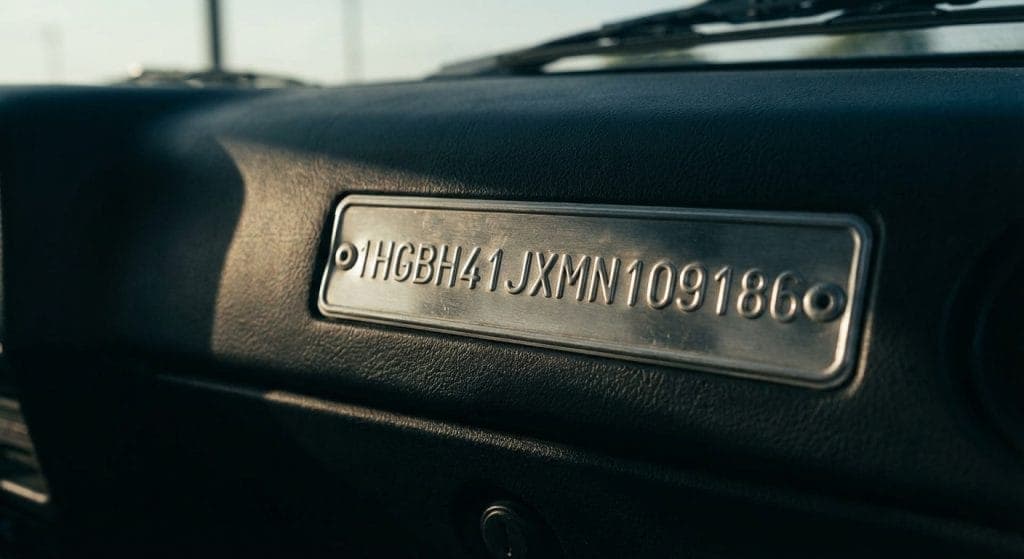
You’re looking at a used car listing and you spot the VIN tucked at the bottom. You know you should probably check it, but you’re not totally sure what it even tells you. That’s exactly what this guide covers.
A VIN, short for vehicle identification number, is a 17-character code that works as a unique fingerprint for every car, truck, or motorcycle on the road. No two vehicles share the same VIN, and once you know how to read one, it gives you a surprising amount of information before you ever take a test drive.
What Does Each Digit in a VIN Mean?
A VIN isn’t random. Every position in those 17 characters means something specific, and knowing what each section represents helps you catch problems and verify what a seller is telling you.
Here’s how the VIN breaks down by position:
- Position 1: Country of manufacture. A “1” means the U.S., “J” means Japan, “W” means Germany, and so on.
- Position 2: The manufacturer. This digit tells you the automaker, like Ford, Toyota, or Honda.
- Position 3: Vehicle type or division. Together with positions 1 and 2, this forms the World Manufacturer Identifier (WMI).
- Positions 4–8: The vehicle descriptor section. This is where you’ll find the model, body style, engine type, and trim level.
- Position 9: A check digit used to verify the VIN is legitimate and hasn’t been tampered with.
- Position 10: Model year. Each year gets its own letter or number code.
- Position 11: The plant where the vehicle was assembled.
- Positions 12–17: The production sequence number. This is the unique identifier that separates your car from every other car built that same year at the same plant.
Using a VIN decoder makes this instant. You paste the VIN in and get the breakdown without memorizing any codes yourself.
What Info Does a VIN Contain?
The short answer: a lot. When you run a VIN check, you’re not just confirming the make and model. You’re pulling the vehicle’s full paper trail.
Yes, a VIN can absolutely tell you the make and model of a car. It also tells you the engine size, trim level, country of manufacture, assembly plant, and model year. That’s the static information baked into the VIN itself.
But when you use a VIN decoder or run a full vehicle history report, the VIN becomes a key that unlocks the vehicle’s entire recorded history. That’s where things get really useful for a used car buyer.
Running a VIN check can reveal:
- Accident and collision history
- Title issues like salvage, flood, or lemon titles
- Odometer readings over time
- Number of previous owners
- Open recalls from the NHTSA
- Theft records
- Service and maintenance history (where reported)
So yes, a VIN can tell you about accidents. It won’t catch every fender bender that never got reported to insurance, but any collision that went through an insurer or was filed with a state agency will typically show up.
One thing a VIN won’t tell you is the current owner’s name or contact details. A VIN is a vehicle identifier, not a registry of ownership. If you’re trying to find out who owns a car, you’d need to go through a state DMV, and even then it’s not straightforward for private individuals.
And no, a VIN won’t tell you the original color the car was painted. Color isn’t encoded into the VIN itself, though some manufacturer window stickers or build sheets associated with a VIN might include it.
What Does a VIN Tell You on a Motorcycle?
The same logic applies to motorcycles. A motorcycle VIN follows the same 17 characters format and gives you the manufacturer, model year, engine displacement, and assembly plant. You can use the same VIN decoder tools you’d use for a car. The NHTSA database includes motorcycles, so you can check for open recalls there too. If you’re buying a used bike, running the VIN is just as important as it is for a car.
What Does Running a VIN Number Tell You for a Specific Brand?
People often wonder if a Ford VIN tells you something different than a Toyota VIN. The structure is universal, but the details vary by brand. A Ford VIN, for example, will tell you which Ford plant assembled the vehicle, the specific engine variant, and whether it’s a base trim or higher package. Same goes for any other automaker. The NHTSA VIN decoder at vpic.nhtsa.dot.gov is free to use and pulls detailed specs for any brand sold in the U.S.
You can also use our free VIN lookup tool to decode any vehicle and pull history details in one place.
What’s a Chassis Number and Is It the Same Thing?
You might hear “chassis number” used interchangeably with VIN, especially on older vehicles or imports. For most modern cars, they’re the same thing. The chassis number is typically stamped on the frame or body of the vehicle and matches the VIN. On vehicles made before 1981, VINs weren’t standardized, so chassis numbers might be shorter or formatted differently. If you’re buying something vintage, pay attention to that distinction.
VIN to Year Decoder Table
Position 10 of the VIN tells you the model year. Here’s a quick reference for recent and common years:
| VIN Character (Position 10) | Model Year |
|---|---|
| A | 2010 |
| B | 2011 |
| C | 2012 |
| D | 2013 |
| E | 2014 |
| F | 2015 |
| G | 2016 |
| H | 2017 |
| J | 2018 |
| K | 2019 |
| L | 2020 |
| M | 2021 |
| N | 2022 |
| P | 2023 |
| R | 2024 |
| S | 2025 |
Note that the letters I, O, Q, U, and Z are never used in VINs because they can be confused with numbers. The sequence skips from 2001 (1) to 2010 (A), then cycles again.
Vehicle Decoder FAQs
Where do I find the VIN on my car?
The most common spot is the dashboard, visible through the windshield on the driver’s side. You can also find the VIN on the driver’s door jamb sticker, your vehicle registration, your insurance card, and on the engine block itself.
Is a VIN check free?
Partially. The NHTSA VIN decoder is completely free and gives you specs and recall data. Our free VIN lookup tool also gives you vehicle details at no cost. Full history reports with accident records and title info are available through paid services like Carfax or AutoCheck, but even the free tools give you a solid starting point.
Can a VIN be faked?
Yes, and it happens. That’s exactly why the check digit at position 9 exists. A VIN decoder will flag a VIN that doesn’t pass the checksum test. If a seller’s VIN doesn’t decode cleanly, or if the VIN plate on the dash looks like it’s been tampered with, walk away. Always match the VIN on the dash to the one on the door jamb and to the title before you buy.
Does the NHTSA track all vehicles?
The NHTSA maintains recall data for all vins registered or sold in the U.S. It’s a critical resource for finding out if your potential purchase has an open safety recall that hasn’t been fixed yet. Always run a VIN against the NHTSA database before buying used.
Can I decode a VIN from a photo or partial number?
Most VIN decoders need the full 17-character string to return accurate results. A partial VIN might get you some info, but you won’t get reliable history data. If you can only see part of the VIN in a listing, ask the seller for the full number before going any further.
Popular Brands, Makes, and Models to Check
Some vehicles come with more complex histories than others, and knowing what to look for by brand helps. Here’s what used car buyers most often want to know by make and model type.
Trucks and SUVs
Ford F-150, Chevrolet Silverado, Ram 1500, Toyota Tacoma, and Jeep Wrangler are among the most searched vehicles in our database. Trucks especially are worth a careful VIN check since many of them get used for towing or off-roading, which can cause wear that doesn’t always show up on the surface. You can browse used trucks and SUVs by make and run a VIN check from the listing.
Sedans and Compact Cars
Honda Civic, Toyota Camry, Hyundai Elantra, and Nissan Altima top the list for used sedan searches. These tend to have multiple owners over their lifetime, so the VIN history is especially useful for understanding how the car was actually used.
Luxury Vehicles
BMW, Mercedes-Benz, Audi, and Lexus are popular in the used market, but maintenance history matters a lot more for these vehicles. A VIN check won’t show every service record, but it will tell you about title issues and accidents, which is critical when you’re spending more money.
How to Use a VIN Before Buying a Used Car
Here’s the practical move. Get the VIN from the listing before you even go to see the car. Run it through a VIN decoder to confirm the specs match what the seller is advertising. Check the NHTSA database for open recalls. Use our free VIN lookup tool to pull vehicle history. If anything looks off, or if the VIN doesn’t decode correctly, that’s a red flag worth taking seriously.
After you’ve cleared the VIN check, get the car independently inspected by a mechanic you trust. A VIN tells you a lot, but it can’t tell you about deferred maintenance or a transmission that’s about to go. The VIN check and the physical inspection work together. Neither one replaces the other.
If you’re financing the purchase, run your numbers through our car loan calculator so you know exactly what you can afford before you get emotionally attached to a specific car.
The VIN is the first thing you should check and the easiest. Don’t skip it.
Was this helpful?
Put it to work. Research your next car or browse our top gear picks.