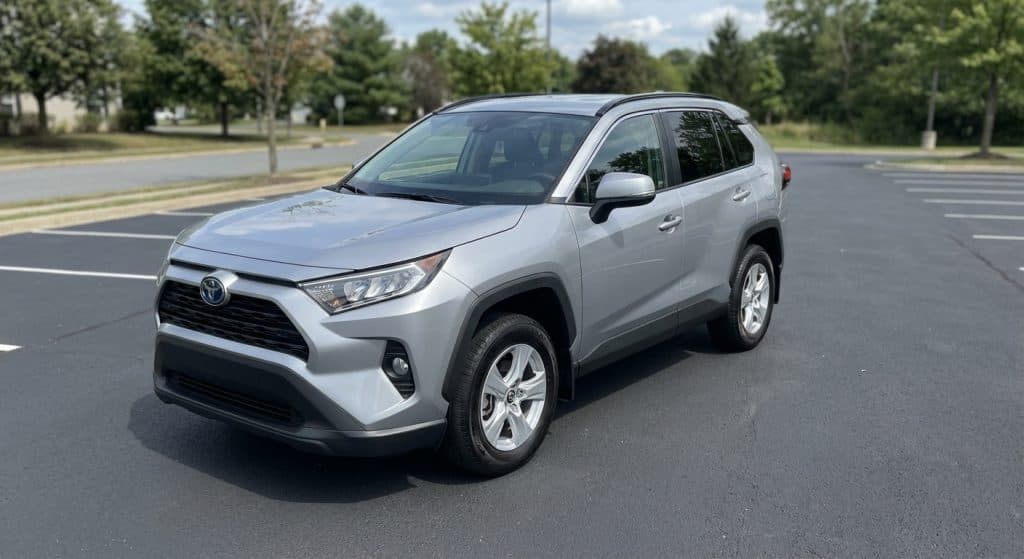
The 2019 Toyota RAV4 is one of the most popular used SUVs on the market right now, and for good reason. But popularity doesn’t mean problem-free, and this generation has a few quirks that could cost you money if you’re not paying attention before you buy.
This review is for the practical buyer who wants a reliable, family-friendly SUV without overpaying or getting stuck with a lemon. Whether you’re looking at a base LE, a loaded Limited AWD, or considering the RAV4 hybrid, here’s what you actually need to know about the 2019 Toyota RAV4 as a used car.
Reliability & Common Issues
The fifth-generation RAV4 launched in 2019, and Toyota had high hopes for it. Overall, owners report a mostly solid experience, but there are some recurring problems you should know about before handing over your money.
What Goes Wrong with a Used Toyota RAV4 (5th-Gen)?
The biggest complaint from real owners is the transmission behavior. The 8-speed automatic on the non-hybrid RAV4 has a reputation for early, jerky shifting, especially at low speeds. Some owners and reviewers at Edmunds have specifically pointed out that the complicated driveline disconnect system and aggressive transmission tuning, while designed to squeeze out better fuel efficiency, can feel rough and unpredictable in daily driving. A few owners have reported transmission failure before 100,000 miles, which is not the kind of reliability you expect from a Toyota.
The door latch and window mechanism issues have also surfaced in owner reports. One Consumer Reports member noted that neither an independent garage nor the dealer could resolve a persistent door problem, and the fix quoted was expensive enough to decline. That’s not a deal-breaker, but it’s a red flag to watch for.
On the hybrid side, the RAV4 hybrid uses a different powertrain setup entirely, and many long-term owners consider it the more refined choice. The hybrid system tends to produce smoother power delivery and fewer drivetrain complaints than the standard 2.5-liter four-cylinder paired with the 8-speed auto.
There are also a handful of NHTSA recalls you should check for the 2019 model year, covering items like the fuel pump and certain safety systems. Before you finalize any purchase, run the VIN through the NHTSA recalls database to make sure all outstanding recalls have been completed.
Other reported issues include:
- Wind noise at highway speeds, particularly around the A-pillar and door seals
- Infotainment complaints, including slow response times and a driver interface that many owners find confusing or poorly designed
- Auto start-stop system irritation, which you can disable each time you start the car but can’t permanently turn off without a third-party module
None of these issues make the 2019 Toyota RAV4 a bad used car. But the transmission is the one to take seriously, especially on higher-mileage examples.
What to Inspect Before You Buy
Always get a pre-purchase inspection from an independent mechanic before buying any used vehicle, including this one. A dealership inspection is not a substitute. Pay someone who has no financial interest in the sale.
For the RAV4 specifically, here’s where to focus your attention:
- Test the transmission hard. Drive it in stop-and-go traffic. Feel for hesitation, clunking, or rough downshifts. A healthy RAV4 should shift smoothly even if it shifts early. Anything that feels jerky or delayed deserves a closer look from a transmission specialist.
- Check all four door latches and windows. Open and close every door. Roll every window up and down. These are cheap to test and expensive to fix.
- Look underneath for rust. The 2019 RAV4 isn’t especially rust-prone, but any used vehicle with road salt exposure deserves an undercarriage check. Look at the frame rails, brake lines, and exhaust components.
- Inspect the hybrid battery if applicable. If you’re buying the RAV4 hybrid variant, ask for a dealer health check on the high-voltage battery. Toyota’s hybrid batteries are generally durable, but a used hybrid with no battery history should be inspected properly.
Also pull the vehicle’s history before you even book the inspection. You can use our free VIN lookup tool to check for reported accidents, title issues, and how many times the vehicle has changed hands. A RAV4 with three previous owners in four years deserves more scrutiny than one with a single owner and service records.
Fair Price Range
The 2019 Toyota RAV4 holds its value well, which is good news if you own one and less exciting if you’re trying to buy one affordably. As a used car, prices vary significantly depending on trim, mileage, and whether you’re looking at the standard model or the RAV4 hybrid.
For a base LE or XLE with average mileage, you’ll typically find pricing in the mid-to-upper range for compact SUVs of this age. A well-equipped 2019 Toyota RAV4 Limited AWD with lower mileage will often command a significant premium, sometimes approaching what you’d pay for a newer model year. The RAV4 hybrid versions typically sell for more than their non-hybrid counterparts, which reflects both demand and the real-world fuel economy advantage.
According to EPA fuel economy data, the standard RAV4 AWD returns around 25 mpg combined, while the hybrid pushes that meaningfully higher. Over years of ownership, that difference in running costs is worth factoring into what you’re willing to pay upfront.
Use our car loan calculator to work out what different price points actually cost you monthly before you get too deep into negotiations. It’s easy to fixate on the sticker price and miss what the total loan cost looks like.
Compare prices from at least three local dealers or private sellers before committing. Prices can swing considerably depending on your region and what’s currently available in your area.
Is the 2019 Toyota RAV4 Worth Buying Used?
Should You Buy a Used Toyota RAV4 (5th-Gen)?
For most buyers, yes. The 2019 RAV4 is a practical, well-rounded SUV with a strong safety record, good cargo space, and Toyota’s reputation for long-term durability. The safety features package on most trims includes Toyota Safety Sense 2.0, which brings automatic emergency braking, lane departure alert, and adaptive cruise control. That’s a meaningful advantage over older competitors.
It can also tow up to 1,500 lbs on the standard model and 1,750 lbs on the hybrid, which is enough for a small trailer or a boat for a weekend trip. It’s not a workhorse, but it handles light towing duty without complaint.
If you’re cross-shopping, a comparable Mazda CX-5 from the same era is worth a look for a more polished driving experience, and a 2021 RAV4 sidesteps some of the early fifth-gen teething issues. But if you find a well-maintained 2019 RAV4 or RAV4 hybrid with a clean history and a good mechanic’s report, it’s a smart buy.
Who should look elsewhere: If a smooth transmission and a refined driving experience are priorities for you, the 8-speed automatic on the non-hybrid RAV4 may frustrate you. Higher-mileage examples, especially those without complete service records, carry real risk given the transmission failure reports in the owner community.
Before you commit to any Toyota RAV4, pull its history. Run a free VIN check on this RAV4 to see reported accidents, title issues, and ownership history.
The 2019 Toyota RAV4 earns its reputation as a dependable used car for everyday buyers. Do your homework, get it inspected, and check that VIN before you sign anything. You can also browse used cars by make to compare what else is available in your area before making a final decision.
Was this helpful?
Put it to work. Research your next car or browse our top gear picks.