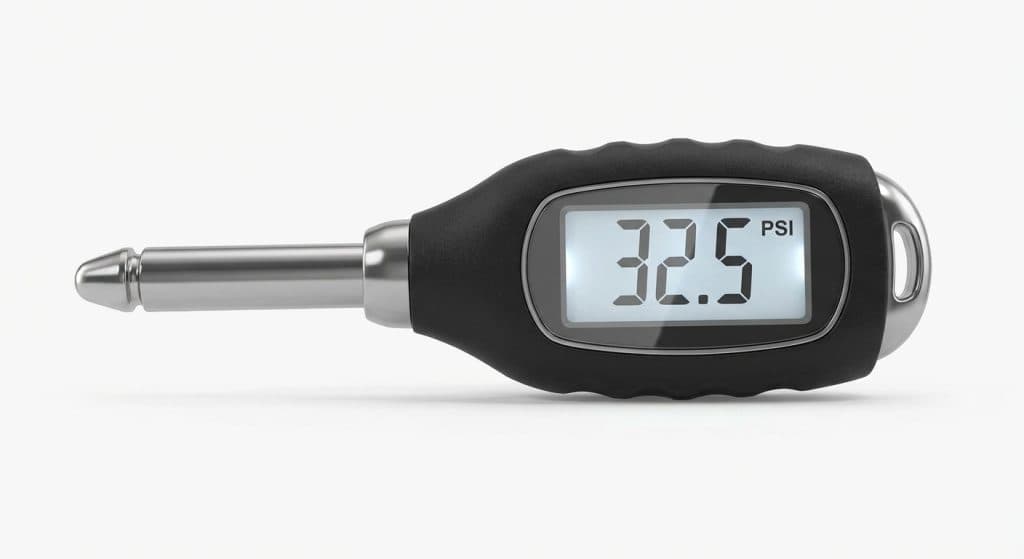
Tire pressure affects fuel economy, handling, and how fast your tires wear. Most drivers check pressure only when the TPMS light comes on, which means they’re already underinflated. A good tire pressure gauge costs less than a car wash and takes a few seconds to use. The cheap pencil gauges from gas stations are notoriously inaccurate. Here’s what to buy instead.
What to Look For
Accuracy: Look for gauges rated to within plus or minus 1 PSI across their full range. Cheap pencil gauges can be off by 3 to 5 PSI, which sounds small until you realize that most passenger car tires should be inflated within 3 PSI of their spec. A 5 PSI error completely defeats the purpose of checking. Digital gauges tend to hold their accuracy longer than dial or stick gauges.
Pressure range: Most passenger cars run 30 to 44 PSI. Truck tires and larger SUVs run up to 80 PSI. High-performance and track tires can exceed 60 PSI when cold. Buy a gauge rated for at least 60 PSI to cover the range you actually drive, with some headroom. Low-range gauges become inaccurate at the top of their scale.
Valve compatibility: Most home gauges use a standard Schrader valve chuck, which fits 99% of passenger cars and light trucks. If you have a vehicle with an unusual stem, verify compatibility before buying. A locking chuck that grips the valve without losing pressure while you read the display is worth the few extra dollars over a push-on chuck.
Durability and bleed valve: A bleed valve lets you release air in small increments while reading pressure, which saves you the hassle of overinflating and then deflating to exact spec. Rubber-coated housings resist drops on concrete. If you keep the gauge in your car, choose one that won’t shatter the first time it falls from the seat to the floor.
Our Top Picks
Best Overall: Accutire MS-4021B Digital Tire Pressure Gauge
The Accutire MS-4021B is accurate to plus or minus 1 PSI across the 5 to 150 PSI range, has a lighted display for low-light use, and costs mid-range. The trigger-style chuck locks onto the valve stem without holding the gauge at an odd angle. It reads in PSI, kPa, BAR, or kg/cm2 and shuts off automatically to preserve the battery.
Pros:
- Plus or minus 1 PSI accuracy across 5 to 150 PSI covers every passenger car, truck, and SUV application
- Illuminated LCD display gives readable numbers in parking garages and pre-dawn checks
- Trigger-style locking chuck holds a seal with one hand; no need to press and hold while reading
Cons:
- Battery replacement requires a small screwdriver; no battery indicator warns before it dies

Accutire MS-4021B Digital Tire Pressure Gauge
Check Price on Amazon →Best Budget Pick: JACO ElitePro Tire Pressure Gauge
JACO’s ElitePro is a pencil-style gauge that actually holds its accuracy, unlike the cheap stick gauges at gas stations. It reads to plus or minus 1 PSI in the 0 to 60 PSI range with a sleeved push rod and rubber chuck. At a budget-friendly price with a lifetime guarantee, it’s the right pick for a glove box spare gauge that you don’t need to baby.
Pros:
- Plus or minus 1 PSI accuracy backed by JACO’s lifetime guarantee against defects and calibration drift
- Rubber-coated chuck doesn’t scratch aluminum valve stems on alloy wheels
- No battery needed; works in any temperature and won’t fail in cold weather where LCD gauges slow down
Cons:
- 60 PSI maximum won’t cover heavy truck or trailer tires that run up to 80 PSI
- Stick readout is harder to read than a digital display in poor lighting
JACO ElitePro Tire Pressure Gauge
Check Price on Amazon →Best Dial Gauge: Milton S-921 Single Chuck Dial Gauge
Some drivers prefer a dial over a digital readout, and the Milton S-921 is the standard that professional mechanics reach for. The 2-inch face dial reads in 2 PSI increments up to 60 PSI. It includes a bleeder valve on the back for precise inflation adjustment. No batteries, no firmware, no display lag. It reads the moment you seat the chuck.
Pros:
- Rear bleeder valve releases air in small increments for precise inflation to exact PSI target
- No battery or electronics; functions in temperatures from -20 to 130 degrees F without performance change
- 2-inch dial face is large enough to read without glasses in awkward wheel well positions
Cons:
- 60 PSI maximum range; not suitable for commercial truck tires or high-pressure applications
- Dial needle can drift over time with heavy use; needs periodic comparison against a reference gauge
Milton S-921 Single Chuck Dial Gauge
Check Price on Amazon →Best Premium Option: Ryobi PCL520B ONE+ Cordless Inflator with Gauge
If you frequently inflate your own tires at home, the Ryobi PCL520B pairs an accurate digital pressure gauge with a cordless inflator. It reads pressure and inflates to a pre-set target PSI automatically, then stops. Not just a gauge, but a complete tire inflation solution for anyone who already owns Ryobi ONE+ battery tools. The gauge is accurate to plus or minus 1 PSI up to 160 PSI.
Pros:
- Preset PSI target mode inflates to exact specification and auto-stops; no manual monitoring needed
- Plus or minus 1 PSI accuracy to 160 PSI covers passenger cars, truck tires, and bicycle tires in one unit
- Ryobi ONE+ battery compatibility means no new charger if you own other Ryobi 18V tools
Cons:
- Premium price is significant if you just need a gauge and not an inflator
- Requires a charged ONE+ battery; not practical for roadside emergency use without power
Ryobi PCL520B ONE+ Cordless Inflator with Gauge
Check Price on Amazon →Also Consider: AstroAI Digital Tire Pressure Gauge 150 PSI
The AstroAI 150 PSI digital gauge is a consistent top seller for good reason. It reads in four units, has a lighted display, covers 150 PSI for truck and trailer tires, and costs mid-range. It doesn’t have the build quality of the Accutire or the brand reputation of Milton, but it performs accurately out of the box and holds up well for regular home use.
Pros:
- 150 PSI maximum range covers commercial truck tires and trailers not covered by 60 PSI gauges
- Four-unit display (PSI, kPa, BAR, kg/cm2) useful when referencing manufacturer specs in different units
- Mid-range price for a digital gauge at this pressure range; significantly cheaper than professional units
Cons:
- Chuck seal is less robust than push-to-lock designs; requires steady hand pressure to prevent air loss during reading
AstroAI Digital Tire Pressure Gauge 150 PSI
Check Price on Amazon →Frequently Asked Questions
What PSI should my tires be?
Check the sticker on the driver’s door jamb or in your owner’s manual, not the max PSI number molded into the tire sidewall. That sidewall number is the maximum the tire can hold, not the operating spec. Most passenger cars run 30 to 36 PSI. Trucks often run 35 to 44 PSI. Check pressure when the tires are cold (before driving, or within a mile of driving) for an accurate reading.
How often should you check tire pressure?
Once a month is the standard recommendation. Tires lose about 1 PSI per month in normal conditions and 1 additional PSI for every 10 degrees F drop in ambient temperature. In winter, you can lose 5 PSI just from the cold without any leak. Most people don’t realize their tires are underinflated until the TPMS light is already on. A quick monthly check prevents that.
Will digital tire gauges work in cold weather?
They will, but LCD displays slow down below 20 degrees F and battery performance drops. If you live somewhere with genuinely cold winters, a dial or stick gauge is more reliable for emergency roadside checks. For normal monthly checks in a garage or mild climate, digital is fine. Keep your gauge at room temperature before use if possible in very cold conditions.
Final Thoughts
The Accutire MS-4021B is the pick for most people: accurate, lit display, locking chuck, and mid-range price. If you want something that never needs a battery, the Milton S-921 dial gauge is what mechanics actually use. On a tight budget, the JACO ElitePro beats every gas station stick gauge on accuracy. Check your tires monthly and you’ll get better fuel economy, more even wear, and fewer surprises on the road.
Published March 22, 2026