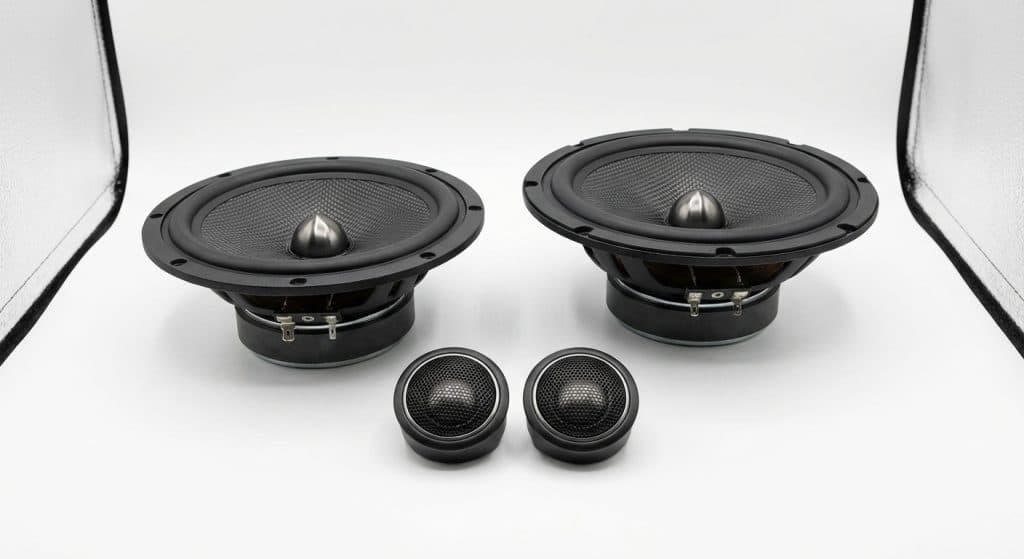
Your factory car speakers were never meant to impress you. They were designed to hit a price point, pass a checkbox, and ship the car out the door. If you’ve been living with muddy bass, a tweeter that sounds like a tin can, or vocals that disappear the moment you hit the highway, you already know the pain. The good news is that swapping your car speaker setup is one of the fastest ways to transform how you feel behind the wheel. You don’t need a full audio system overhaul. The right pair of 6.5 speakers can make a bigger difference than you’d expect, and you don’t have to spend a fortune to hear it.
What to Look For
Before you buy, a few things actually matter when sorting the good from the forgettable.
Coaxial vs. Component Speakers
A coaxial speaker puts the woofer and tweeter in one unit. It’s easy to install and works great for most people doing a basic upgrade. A component speaker system separates the woofer, tweeter, and crossover into individual pieces, giving you better staging and clarity, but also more work to install. If you’re replacing factory speakers in a stock setup, a 2-way coaxial speaker is usually the right call. If you’ve got an amplifier and you care deeply about sound quality, a component speaker system is worth the extra effort.
RMS Power Handling
Ignore the peak wattage numbers. They’re marketing fluff. What you want is the RMS rating, which tells you how much continuous power the speaker can handle without distortion or damage. If you’re running off a factory head unit, you’re pushing maybe 15 to 18 watts RMS per channel. A speaker rated at 50 to 75 watts RMS will pair well with an aftermarket amplifier if you ever decide to add one later.
Sensitivity Rating
Sensitivity measures how loud a speaker gets from a given amount of power, rated in decibels at 1 watt at 1 meter. Higher sensitivity (90dB and up) means the speaker works well with low-power factory stereo setups. Lower sensitivity speakers need more power, so they’re a better match if you’re running an amplifier.
Cone and Tweeter Materials
The cone material shapes the midrange tone. Polypropylene cones are durable and resist moisture, which matters in a car door. Woven glass fiber cones are stiffer and handle the midrange more cleanly. For the tweeter, silk dome tweeters are smoother and easier on the ears at high volumes. Mylar dome tweeters are brighter and more aggressive. Neither is wrong, but knowing which you prefer helps you pick the right car speaker for your taste.
Our Top Picks
Best Overall: Alpine S-S65
The Alpine S-S65 is a 6.5 component speaker system that punches well above its price. Alpine designed these with a woofer that uses a pulp and fiber cone for tight, controlled midrange, and a tweeter that opens up the high end without getting harsh. The crossover is clean and well-tuned, which means the handoff between the woofer and tweeter is seamless. This is the alpine car audio product that keeps showing up on shortlists for a reason.
Pros:
- 75 watts RMS power handling pairs cleanly with most aftermarket amplifier setups
- Silk dome tweeter stays smooth at high volumes without the listening fatigue you get from cheaper tweeters
- Separate tweeter mount gives you placement flexibility that a standard coaxial speaker can’t match
Cons:
- Component speaker installation takes more time than a drop-in coaxial speaker swap
- Needs at least a modest amplifier to really open up; underwhelming off a factory head unit alone

Alpine S-S65 Component Speaker System
Check Price on Amazon →Best Budget Pick: Kicker CSC65
The Kicker CSC65 is a 6.5 coaxial speaker that keeps things simple and affordable. It’s a 2-way design with a polypropylene cone woofer and a PEI dome tweeter, rated at 50 watts RMS. For someone replacing blown factory speakers who doesn’t want to get complicated, this is a solid starting point. Kicker has had mixed reviews in some enthusiast circles, but at this price for basic coaxial duty, it earns its spot.
Pros:
- 50 watts RMS with 200 watts peak handles typical factory stereo power without distortion
- Polypropylene cone resists humidity and temperature swings common in car door environments
- Drop-in 6.5 fit works in a wide range of factory mounting locations without modification
Cons:
- PEI tweeter sounds slightly brittle compared to silk dome tweeters at higher volumes
- Midrange detail drops off noticeably compared to step-up component speaker options
Kicker CSC65 Coaxial Speaker
Check Price on Amazon →Best for Sound Clarity: JBL Club 622
If clarity is your priority, the JBL Club 622 is the 6.5 coaxial speaker to beat at its price point. JBL builds this one with a Plus One cone, which increases the effective cone area without changing the mounting size, meaning more air moved and better low-end response from a standard 6.5 footprint. The tweeter sits on a swivel mount, so you can angle it toward the listening position. JBL is one of the brands that consistently earns praise from car audio enthusiasts looking for value without sacrificing sound quality.
Pros:
- Plus One cone increases radiating area by roughly 20% compared to a standard 6.5 cone, improving bass extension
- Swiveling tweeter mount allows precise aiming without custom fabrication
- 60 watts RMS works well with or without an amplifier for flexible use in different setups
Cons:
- The 2-way coaxial design doesn’t separate the tweeter from the woofer, limiting soundstage depth compared to a component speaker setup
JBL Club 622 Coaxial Car Speakers
Check Price on Amazon →Best Premium Option: Alpine S-S65C
When you want the best alpine has to offer in a component speaker package, the S-S65C is the step up from the already-excellent S-S65. The tweeter is a refined silk dome unit with a wider frequency response, and the woofer cone uses a glass fiber and pulp blend that keeps the midrange tight even when an amplifier is pushing real power. Alpine voiced this component speaker system specifically for car audio environments where road noise is a constant challenge. It’s a premium investment, but the audio system transformation is real.
Pros:
- 100 watts RMS handles high-output amplifier setups without compression or breakup
- Glass fiber woofer cone maintains accurate midrange reproduction at volume levels where polypropylene cones start to distort
- Passive crossover uses high-quality components that minimize phase shift between the woofer and tweeter
Cons:
- Premium price requires a matching amplifier investment to justify the upgrade, making the total cost significant
- Installation requires running separate tweeter wiring, which adds time for a DIY installer
Alpine S-S65C Component Speaker System
Check Price on Amazon →Also Consider: Memphis Audio PRX602
The Memphis PRX602 is a 6.5 coaxial speaker that flies under the radar but delivers more than its price suggests. It’s a 2-way design with a polypropylene cone woofer and a balanced dome tweeter, rated at 50 watts RMS. Memphis Audio has been making car audio gear since 1965, and their build quality shows in how solid these feel compared to generic alternatives. If the JBL and alpine options are out of stock or out of budget, this is a dependable backup worth considering.
Pros:
- 50 watts RMS with a sensitivity rating of 91dB, meaning it performs well even off a modest factory stereo
- Rubber surround on the woofer cone provides better durability and bass extension than foam surround alternatives
- Mounting depth of 2.4 inches fits most shallow factory door locations without spacers
Cons:
- The tweeter doesn’t swivel, limiting your ability to adjust the high-frequency aim
- Less widely stocked than JBL or alpine options, so availability can be inconsistent
Memphis Audio PRX602 Coaxial Car Speakers
Check Price on Amazon →Frequently Asked Questions
What’s the difference between a coaxial speaker and a component speaker for a car?
A coaxial speaker is an all-in-one unit where the tweeter mounts directly on top of the woofer cone. It’s simpler to install and works well for most everyday upgrades. A component speaker system separates the woofer, tweeter, and crossover into distinct pieces, which gives you better control over placement and usually better sound staging. Component speakers are the right call if you have an amplifier and care about getting the most out of your car audio setup.
Are JBL car speakers actually good?
Yes, JBL makes genuinely strong car speakers, particularly at the mid-range price point. Their Club series coaxial speakers consistently score well with car audio enthusiasts for clarity and bass response. The Plus One cone technology is a real engineering feature, not just a marketing claim. JBL and Infinity are frequently cited as offering the best value-to-performance ratio among mainstream car audio brands.
What’s the best car speaker size for most vehicles?
The 6.5 inch size is the most common and the most versatile. It fits the front doors of the majority of cars and trucks sold in North America, and it’s the size you’ll find the widest selection of coaxial and component speaker options in. Always check your specific vehicle’s factory speaker size before buying, because some cars run 5.25, 6×9, or other sizes depending on the trim and market.
Final Thoughts
If you want the best overall car speaker upgrade without overcomplicating things, start with the Alpine S-S65. It’s a component speaker system that works with most amplifier setups and delivers a sound quality jump you’ll notice immediately. On a tight budget, the JBL Club 622 coaxial speaker gives you more for your money than almost anything else in its class. Going premium? The Alpine S-S65C component speaker system is built to last and tuned to handle real amplifier power. Whatever you pick, get it installed, turn it up, and enjoy the car you already have a whole lot more.
Published March 22, 2026